Mara River crossings peak August – September · limited northern camps remain
Tanzania · Choose Your Star
Enter to open first result · Esc to close

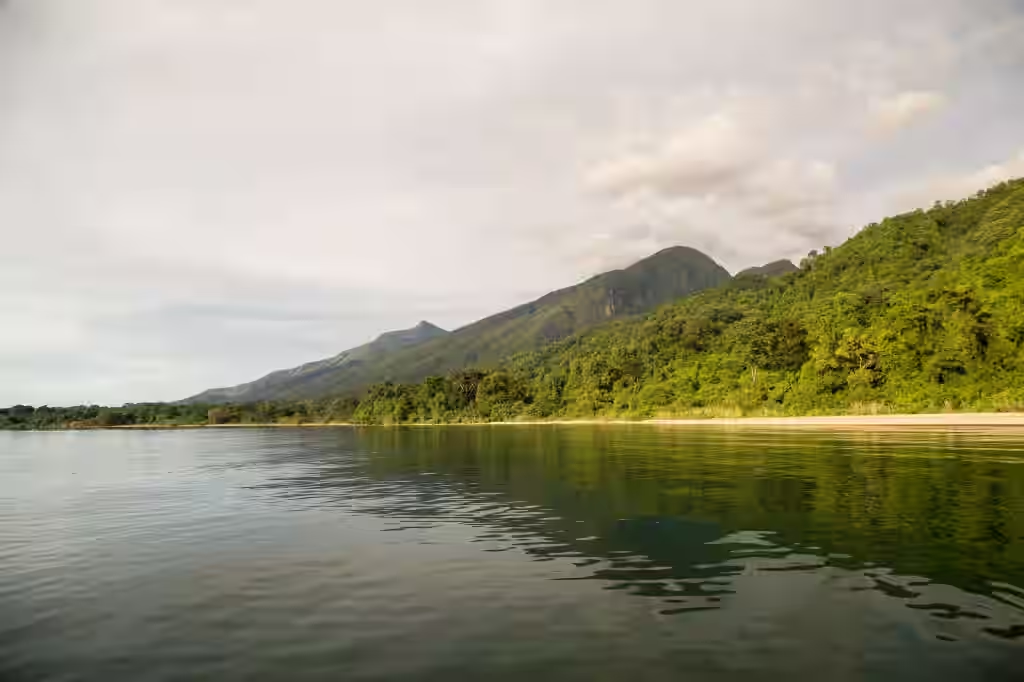
Around a thousand wild chimpanzees, no roads, and a white-sand beach on the second-deepest lake on Earth.
Mahale is the most remote place most of our travellers will ever go, and the one they talk about longest afterwards. There are no roads into the park — you arrive by light aircraft onto a grass strip and then transfer by boat along the shore of Lake Tanganyika.
The mountains rise straight out of the lake to nearly 2,500 metres, covered in dense forest. Living in that forest are around a thousand chimpanzees, including the M-group, habituated to human presence by Japanese researchers from Kyoto University since the 1960s — one of the longest continuous primate studies in the world.
The trek to find them is genuinely demanding. Chimps move constantly, so trackers set out at dawn to locate the group and you follow. It might be forty minutes; it might be four hours of steep, humid, root-tangled climbing. Once found, you get exactly one hour, masked, at a minimum distance.
What makes Mahale extraordinary rather than merely rare is the setting. You come down from the forest, sweat-soaked, and swim in water so clear you can see thirty metres down, with the Congo on the far horizon. Nowhere else combines those two things.
Chimpanzees, a freshwater sea, a mountain range and complete isolation — in one park.

Around sixty individuals habituated over six decades of continuous research. Grooming, hunting, politics and play, observed from a few metres in wild forest.

The second-deepest and among the clearest lakes on Earth, holding over 250 endemic cichlid species. Snorkelling here is genuinely world-class.

The park's sacred peak at 2,462 m, reached on a two or three day trek through forest into montane grassland with views across to the Congo.

A handful of camps sit directly on white sand between forest and water. No roads, no vehicles, no other visitors — just dhows and the sound of the lake.
Mahale is not a Big Five park. It is a primate and freshwater destination, and on those terms it is unmatched.
There are no lion, rhino or giraffe here, and elephant and buffalo are present but rarely seen in the forest. Come for chimpanzees, other primates and the lake. Travellers wanting classic savanna game viewing should pair Mahale with Ruaha or Nyerere rather than expecting it here.
Chimpanzees in the morning, the lake in the afternoon. That is the rhythm, and it is a very good one.
Trackers locate the M-group at dawn and you follow. One hour with the chimps once found, masked and at distance. Physically demanding and utterly worth it.
Over 250 endemic cichlid species in water clear to thirty metres. Genuinely among the best freshwater snorkelling anywhere in the world.
Through forest into montane grassland to the park's sacred summit, camping on the mountain. Very few visitors ever do it.
Paddling the shoreline or sailing a traditional dhow as the sun drops behind the Congo mountains across the water.
Lower-forest walking on non-trekking days, looking for red colobus, blue monkey, forest birds and butterflies with a guide.
The Kyoto University station has run continuously since the 1960s. Occasional talks with researchers give real depth to what you've just watched.
Mahale's camps operate seasonally and the wet months make the forest trails genuinely dangerous.
Mahale has very few beds. Book early or don't go — there is no walk-up option this remote.

Timber and thatch bandas on white sand with the forest behind and the lake in front. Among the most beautifully sited camps anywhere in Africa.

Simpler canvas directly on the shore, with excellent guiding and the same chimp access. Far better value for what is fundamentally the same experience.

Basic park-run accommodation at Kasiha. Simple and cheap by Mahale standards, with the same trekking permits and guides.
Mahale needs charter flights, so it works best inside a longer western or southern routing.
Katavi safari, Mahale and Gombe chimpanzees, and Lake Tanganyika. Tanzania's wildest and least-visited circuit.
View Itinerary →
Four nights on the lake with multiple treks, snorkelling and forest walks. The single-destination version, done properly.
Enquire →
Ruaha, Nyerere and Mahale by light aircraft. Savanna predators and forest primates in one journey.
Enquire →
Mahale's chimpanzees and Tanganyika, followed by the Indian Ocean. Two very different kinds of water.
Enquire →Most journeys combine two or three. Tell us which pull at you and we will build the route.
Mahale has very few beds and fixed charter schedules, so it books out early. Tell us your dates and we'll check availability now. No cost, no commitment.
 ✓Live specialist
✓Replies within 1 hr
✓Live specialist
✓Replies within 1 hr
Tell us a little about the trip you have in mind. A planner in Arusha will write back within one working day.
Speak with us directly on WhatsAppinto wilderness toursPlanner